

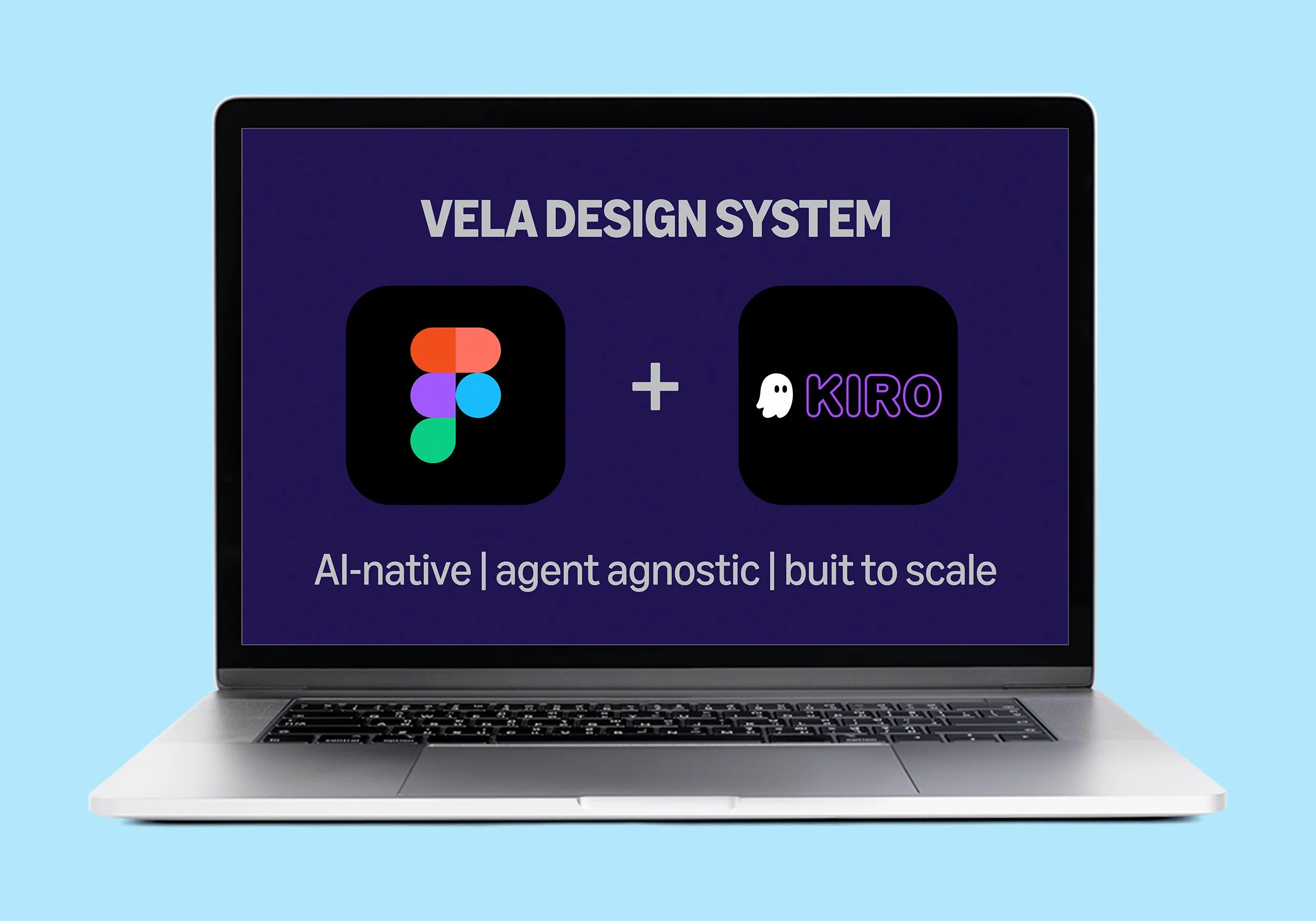
VELA AI-Ready Design System
Proposed, resourced, and launched an AI-ready design system that enabled agentic AI workflows across Amazon Devices—turning a VP-level aspiration without a plan or resources into a force multiplier for design, engineering, and product teams.
The problem
Building integrated AI development workflows—where an agent can turn a natural language prompt into a design mockup, or a design directly into production code—requires a design system that functions as a knowledge base. Amazon Devices had built bespoke components and patterns on top of Amazon's central design system for years, but had never codified them into a proper system where Figma components matched consistent code expressions. Without that foundation, agentic AI workflows had nothing reliable to work from. The organization needed to define what "AI-ready" even meant for a design system, audit what existed against that standard, close the gaps, and build out the components and aligned code expressions unique to Devices—all while carrying a full portfolio of competing business priorities.
My role
I identified this as a critical organizational gap before it was resourced or planned, proposed it as a VP-level goal, secured dedicated headcount, and led the cross-functional work to get it off the ground. I defined the approach, organized and ran the three-day workshop that produced the first output, managed the team through a deliberate pilot-and-pivot process, and kept the initiative moving toward an MVP.
A significant part of my role was people leadership in two directions: building the organizational case upward to get the initiative funded and protected, and developing a mid-level designer into a scope well beyond his level. I deliberately gave this project to a designer who had the hard skills to do the work but had never operated at this level of organizational complexity or strategic visibility. Coaching him through it—and watching him grow into the role—was as important to me as shipping the system itself.
What I did
Turned an unfunded organizational aspiration into a resourced initiative. The VP-level planning document flagged disappointment that this work wasn't further along—despite the fact that it had never been planned or resourced. Rather than push back on the framing, I used it as leverage. I proposed VELA as a VP-level goal for 2026, volunteered to own the operational planning document for our design and research org, and drove alignment with my design director to carve out two dedicated headcount—one to build the system and one to drive the agentic workflows around it. When a business and tech director challenged the dedicated headcount model, I argued that the foundational work required focused ownership, not designers contributing in the margins of other priorities, and that getting the foundations right would force-multiply the output of every designer, engineer, and product manager who used it.
Made a hiring bet on AI fluency before the org knew it needed it. About a year before VELA was initiated, I hired a designer with a master's specialization in AI into a role leveled for a more senior generalist. I made that call because I knew AI domain expertise wasn't on my team and I knew I would need it. When that designer completed a critical project, I cleared his plate and redirected him to figure out how to approach this initiative—and he laid the technical foundation the work was built on.
Gave a mid-level designer a senior-level scope and coached him through it. I assigned VELA's design system development to this designer as a deliberate stretch—not because it was the easy call, but because I could see he had the technical depth to do the work and needed the organizational challenge to grow. What he didn't have yet was fluency in how to navigate a project of this complexity: how to structure a gap analysis, how to design a workshop that produces alignment rather than just conversation, and how to shape a launch announcement that builds strategic visibility across the org. I coached him through each of those things directly—the gap analysis criteria, the three-day workshop agenda and materials, the stakeholder mapping, the communication strategy. He grew into the role and executed a significant volume of work before we brought on a senior product designer with the right technical skills to join him. I'm now preparing his promotion case on the back of this project, where he demonstrated the ability to operate at a scope well beyond his level.
Ran a three-day cross-functional workshop that produced the first output. Getting UX, visual design, and engineering aligned on the structure of the system, how to keep design and code expressions in sync, and what to prioritize first required more than meetings—it required dedicated time with the right people in the room. I organized and led a three-day workshop structured deliberately: leaders attended sessions where we aligned on goals and made critical decisions; the working group owned the sessions where we figured out how to execute. The preparation and structure meant we left with a minimum lovable product containing the first components, not just a plan.
Piloted, learned, and pivoted before committing to the wrong workflow. Rather than mandate a new way of working, I identified a pilot project for the Figma-to-code workflow, had the feature designer partner with the AI system designer to document what they did, ran a cross-functional post-mortem, and built a playbook. When a second designer applied the playbook and found it too onerous, I treated that as signal rather than failure. Within two months of starting the pilot cycle, I pivoted the team toward a parallel path we'd been exploring—using an AI coding agent called Kiro as the design interface, taking Figma out of the workflow entirely. Engineering leadership needed convincing, and the key to that conversation wasn't a deck—it was a live demonstration of how it worked.
Created the conditions for the org to self-discover what the system could do. The most compelling proof of VELA's value didn't come from me — it came from designers across the organization figuring out what it unlocked on their own. A senior designer not on my direct team used VELA and Kiro to build a BuyBox tool that automatically generated all 39 customer states across four countries and multiple languages for the Alexa+ subscription experience — a tool that took eight hours to build and has already saved 20+ hours by enabling marketers and localization partners to self-serve copy review and translation management independently. Another designer used VELA to explore interactive, motion-intensive storytelling features for the Alexa+ subscription page in hours — explorations that previously would have taken weeks and required engineering involvement. Those explorations gained executive alignment and are currently in development.
See demo of VELA + Kiro in action below:
VELA codified Devices' bespoke design patterns into a system where design expression and code expressions align—the foundation that makes agentic AI workflows possible.
The outcome
Launched an MVP design system that enabled two distinct agentic AI pilot workflows: Figma-to-code and natural language prompt-to-design. Early applications demonstrated immediate force multiplication a single tool built on VELA delivered a 300% efficiency improvement on one workflow alone, with ongoing gains as more teams adopt it. The system is now the foundation for how Amazon Devices approaches AI-assisted design and development.
What this demonstrates
This project shows how I identify a foundational organizational gap before it becomes a crisis, build the case to resource it, and lead a cross-functional team through the ambiguity of figuring out something that hasn't been done before. It also shows how I develop people—giving a mid-level designer a senior-level challenge, coaching him through the organizational complexity, and building the conditions for him to grow visibly in front of the right people.
For any organization navigating AI transformation in its design and development practice, the strategic question VELA was built to answer is the same: how do you stop making faster facsimiles and start shipping the real thing?
Where VELA is heading
The system has unlocked meaningful efficiency gains—but the deeper opportunity is still ahead. Right now, even with VELA in place, most teams are still operating within a sequential artifact-handoff model: designers create static mocks, hand them to engineers, engineers interpret and rebuild, and misalignment surfaces late. We're making facsimiles of experiences faster—but they're still facsimiles, and the handoff seams still introduce churn, rework, and lost intent.
The real unlock isn't faster mocks. It's eliminating the gap between the design artifact and the shipped product entirely. When agents can generate production-viable code directly from design system components, the artifact is the product—and the team working on it should be cross-functional and concurrent, not sequential and siloed.
The next step is a pilot of a shared-artifact model on an upcoming feature, where design, engineering, and product work in tandem on a single environment from the start—with the goal of shipping what's built collaboratively rather than handing off a representation to be rebuilt. That pilot will surface what needs to change in team structure, mechanisms, and tooling to scale this model across the org. VELA is the foundation that makes it possible.
What I'd do differently
The engineering alignment I built was real but incomplete. I had buy-in from the engineering director and several individual contributors working directly on the project—but I missed a key senior engineering manager and the engineering manager who ultimately ended up owning the initiative. That gap in the middle layer didn't derail the project, but it made conversations harder than they needed to be. Leaders who hadn't been brought along for the ride needed the strategy explained after the fact rather than having built conviction alongside us.
If I were doing this again, I'd push earlier not just for alignment with the most senior engineering leaders, but specifically for an engineering management owner I could work with directly from the start. The IC partnership was strong. The director relationship was solid. But the missing middle layer cost us in conversations that should have been easy and weren't. At the scale this initiative needed to operate, every layer of engineering leadership needed to be a co-owner, not a recipient of updates.