

Just Walk Out Technology Design Jam
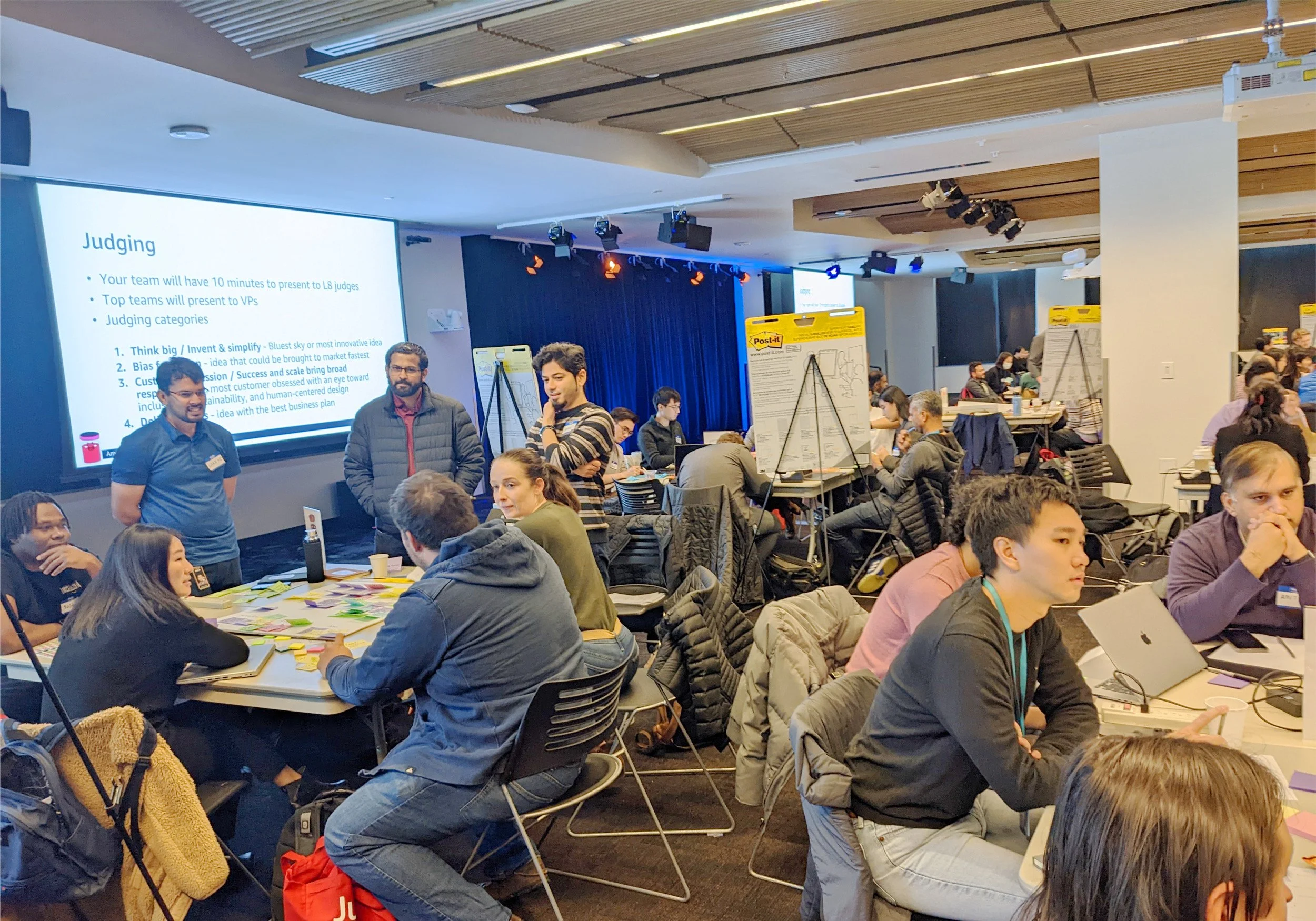
Designed and facilitated a 125-person cross-functional innovation workshop that generated 15 new business concepts for Just Walk Out Technology—several of which gained traction with leadership and were connected to business development teams for further exploration.
The problem
Just Walk Out Technology worked—but the business case wasn't strong enough to justify the investment at scale. The challenge wasn't technical. It was strategic: how could Amazon's existing Just Walk Out infrastructure be reconfigured to solve different customer problems and generate new revenue streams beyond autonomous retail? The answer required bringing together people across functions who understood the technology, the customer, and the business—and giving them a structured way to find the intersection.
My role
As principal UX designer, I designed the entire workshop from the ground up—the preparatory materials, the facilitation framework, the tools teams used to develop their concepts, and the structure that took 125 people from a creative brief to 15 strategy-ready business concepts in a single day.
What I did
Translated complex technology into a creative brief non-technical participants could actually use. Before anyone could generate viable ideas, they needed to understand what Just Walk Out's underlying components could actually do—not how they worked technically, but what problems they were uniquely capable of solving. I interviewed a senior principal engineer, reviewed technical documentation, and wrote a document that broke the technology down into three core capabilities: determining who is in a space, what they're interacting with, and where they are at any moment. I documented each hardware and software component in a consistent framework—what it is, where it lives in a store, why it exists—and paired each one with thought starters designed to stretch participants' thinking beyond retail. That document became the foundation for the pre-workshop info session and the day itself.
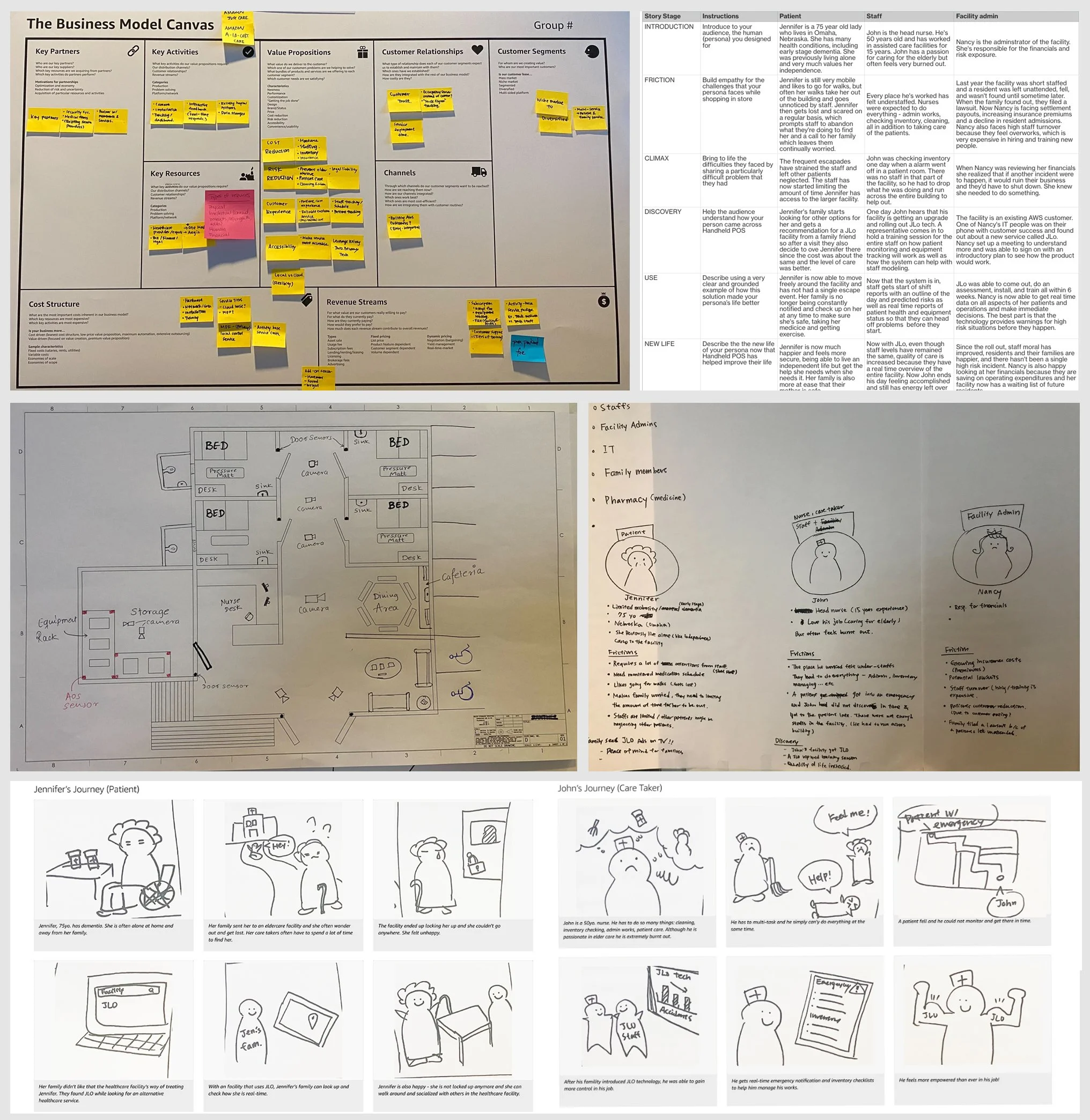
Structured the day so 125 people moved from divergence to a deliverable. The workshop followed an understand, diverge, converge, build, and test arc. Teams of approximately seven were balanced across function, tenure, and level—deliberately mixing perspectives rather than clustering by expertise. After a shared review of the technology primer and market research delivered by our head of research, teams moved through structured brainstorming using the thought starters as prompts, narrowed to a single concept, and built it out using a business model canvas I adapted for this context. Teams then got feedback from other groups, iterated, and turned their concept into a mini-PRFAQ—a one-page strategy document using a template I created. Presentations to director and VP leadership followed on subsequent days.
Used the business model canvas to push ideas toward viable strategy, not just creative concepts. The creative brief was deliberately dual-sided: "How might we leverage existing Just Walk Out capabilities to create new, innovative, and profitable experiences that delight customers?" Delight alone wasn't the bar—viability was. I chose the business model canvas because it forces teams to articulate value proposition, customer segments, revenue streams, and cost structure together, which surfaces whether an idea is actually a business or just an interesting thought. Pairing it with the mini-PRFAQ format gave leadership something concrete to evaluate, not just a set of workshop outputs.
Trained and deployed the design and research org as a facilitation infrastructure. With 125 participants across simultaneous workstreams, I couldn't facilitate everything myself. I trained the design and research team ahead of the workshop to serve as facilitation leads—one per team—so every group had dedicated support. I kicked off the day, moved between teams throughout, cleared blockers, and supported facilitators where they needed it. The design org wasn't just a participant in the innovation process—it ran it.
See below example artifacts from the workshop:
The outcome
Generated 15 new business concepts with accompanying strategy documents, spanning domains from healthcare to agriculture to fitness to parking—a range that surprised even the leadership team reviewing the outputs. Several concepts gained enough traction that participating teams were connected directly with business development teams, particularly focusing on exploring solutions in healthcare and agricultural markets.
What this demonstrates
Retailers and technology companies investing in new capabilities face a consistent challenge: the technology exists, but the full range of what it could do for customers and the business hasn't been mapped. This project shows how I bring design thinking to strategic business problems—creating the structure, tools, and facilitation infrastructure that moves a large, cross-functional group from ambiguity to actionable business concepts in a single day. The transferrable skill is knowing how to make innovation feel rigorous rather than just creative.