

Just Walk Out Technology Communication System
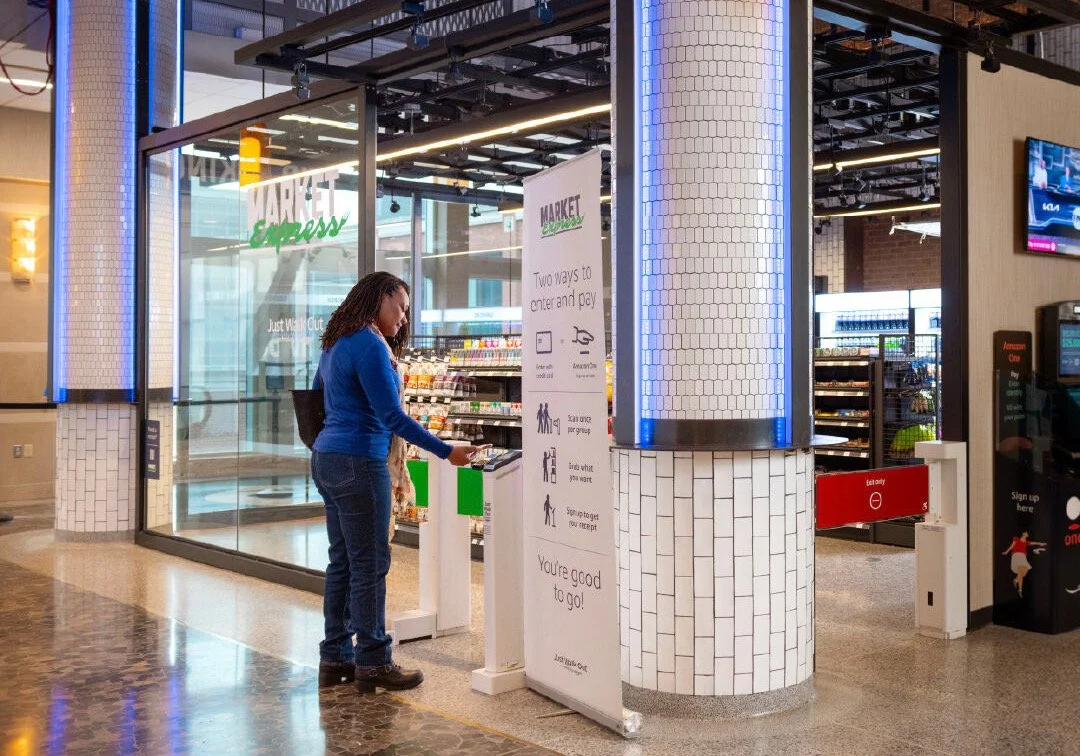
Identified a customer confusion problem that was costing Just Walk Out Technology retail partners—and built a standardized communication system from scratch that gave customers the mental model they needed to walk in, shop, and leave efficiently, securing $1.3M in funding and enabling the go-to-market team to scale new store launches without starting over every time.
The problem
Just Walk Out Technology promised something genuinely novel—walk in, grab what you want, walk out. No checkout, no cashier, no friction. But customers approaching a Just Walk Out store for the first time saw something very different: gates blocking their path, no obvious instructions, and no one to ask. Some approached associates for help—which defeated the entire promise of autonomous retail and pulled staff away from other work. Some tried to figure it out and gave up. Some saw the gates and didn't approach at all. Retailers were noticing—stores with better customer guidance outperformed stores without it, and some retail partners were reluctant to adopt or expand the technology because customer confusion was undermining confidence in it.
The communication problem was compounding in every direction. Each new store was inventing its own explanation from scratch, creating inconsistency in how the technology was understood across locations. The small go-to-market team couldn't keep up with the volume of bespoke assets each launch required. And there was no agreed boundary between where Amazon should control the brand and messaging and where the retailer should—a tension that was creating friction with partners who wanted full control, at the risk of fragmenting the customer experience further.
My role
As principal UX designer, I identified this as a systemic problem that needed a strategic solution—not another one-off asset—wrote the strategy document that defined the direction and secured VP-level funding, led the agency partnership that developed and validated the system, and built the guidelines and tools the go-to-market team needed to scale independently.
What I did
Named the real problem before anyone had framed it as a solvable one. The challenge wasn't necessarily that individual store materials were poorly designed—it was that there was no shared mental model for what Just Walk Out technology was or how to use it. Customers had no frame of reference. Explaining the underlying technology—computer vision, sensor fusion—would destroy the seamlessness the experience was meant to deliver. The insight that drove the framework was simpler: customers needed to understand three things before they entered, and nothing more—how to pay and enter, how to shop, and how to leave. Everything else—receipts, privacy policy, hardware details —could be addressed contextually at the moment customers needed it, not upfront.
Wrote a PRFAQ to define the strategy and secure funding. My design director understood the problem, but the VP who controlled the budget didn't—and without his understanding of both the customer impact and what it would take to solve it properly, the work wouldn't get resourced. My director suggested I write the PRFAQ (the type of strategy document required for new project funding at Amazon), and I used it to codify the problem, define the solution approach, and make the case for investment in development, user testing, and a continuous improvement mechanism with retail partners. The VP approved $1.3M in funding.
Built an MLP to unblock the business while the full system was being developed. The go-to-market team couldn't wait for a fully validated system—they had stores to launch. I put together a minimum lovable product and a best first draft of materials to give them something to work with immediately, while the agency developed, tested, and iterated on the full system in parallel. That sequencing kept the business moving without compromising the quality of what we were building.
Selected and led an agency partnership across creative, strategy, and timelines. My internal team didn't have designers who specialized in environmental graphics or physical communication systems, and we didn't have the capacity—everyone was working on other critical initiatives. I selected an agency to fill that gap and directed them across all three dimensions: creative direction, strategic alignment, and delivery timelines. The agency became an extension of the team, not a vendor executing a brief.
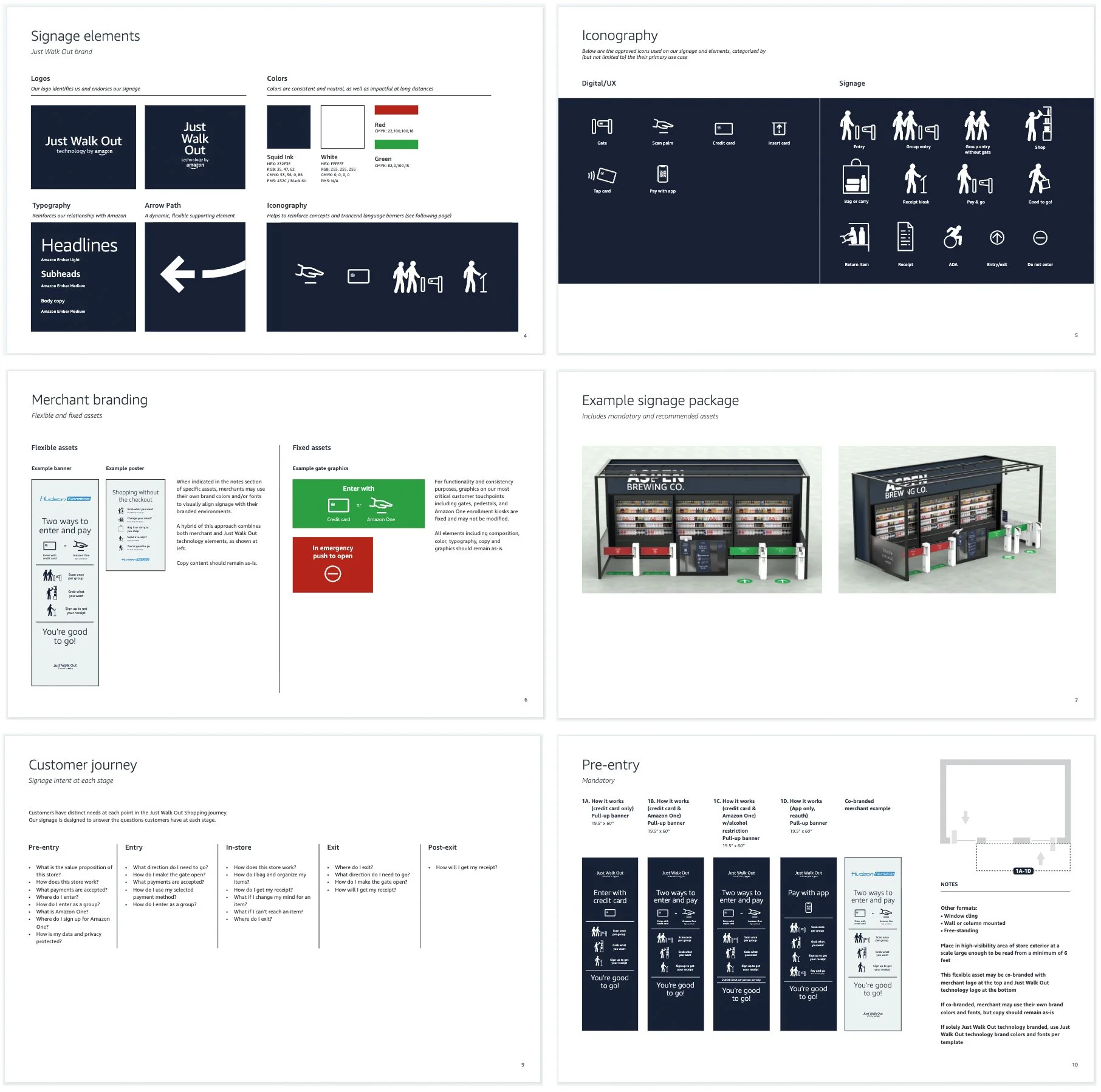
Resolved the brand control tension between Amazon and retail partners. Some retailers wanted full control over how the experience was branded and communicated—a reasonable instinct, but one that risked fragmenting the customer experience across locations. I established a clear framework for where Amazon set the standard and where retailers had flexibility, giving partners ownership of the elements that were genuinely theirs while protecting the consistency that made the system work for customers.
Handed off a system the team could run independently. The goal was never for this to require ongoing design involvement to execute. I directed the agency on building the guidelines, trained the go-to-market team on how to use them, and delivered the templates and kit-of-parts needed to execute across new store launches without starting from scratch each time.
See below excerpts of the MLP guidelines shared with merchant partners:
The outcome
Secured $1.3M in investment to develop, validate, and continuously improve the system. Delivered a standardized communication framework that scaled across multiple retailer configurations—different entry mechanisms, payment methods, and underlying technology—without requiring bespoke asset development for each new launch. The go-to-market team could execute new store launches independently using the guidelines, templates, and kit-of-parts the system provided.
What this demonstrates
Retailers introducing new technology—whether that's frictionless checkout, AI-assisted shopping, or any experience customers have no existing mental model for—face a version of this problem: the technology works, but customers don't know what to do with it. This project shows how I identify that gap at the strategic level, build the organizational case to fund a real solution, and deliver something the business can scale without needing design involved in every execution. The transferrable skill is knowing how to make a genuinely novel experience feel intuitive to a customer who's never seen anything like it before.
What I'd do differently
I started this project by auditing the existing first-party store installations—visiting Whole Foods Market and Amazon Fresh Just Walk Out locations and documenting what was working and what needed to be standardized. That work had value, but in retrospect it wasn't where the bleeding was. The existing stores weren't going anywhere, and there wasn't real organizational appetite to overhaul them. The acute problem was third-party stores: they were opening quickly, they needed to make signage decisions fast, and every week without a standard system meant another store launching with something inconsistent or ineffective. If I were doing this again, I'd have spent less time on the retrospective audit and moved directly to the forward-looking problem—getting a minimum viable communication system in front of the third-party store pipeline as quickly as possible, and treating the first-party store standardization as a second phase once the urgent need was met.