

Amazon Devices Brand Sites
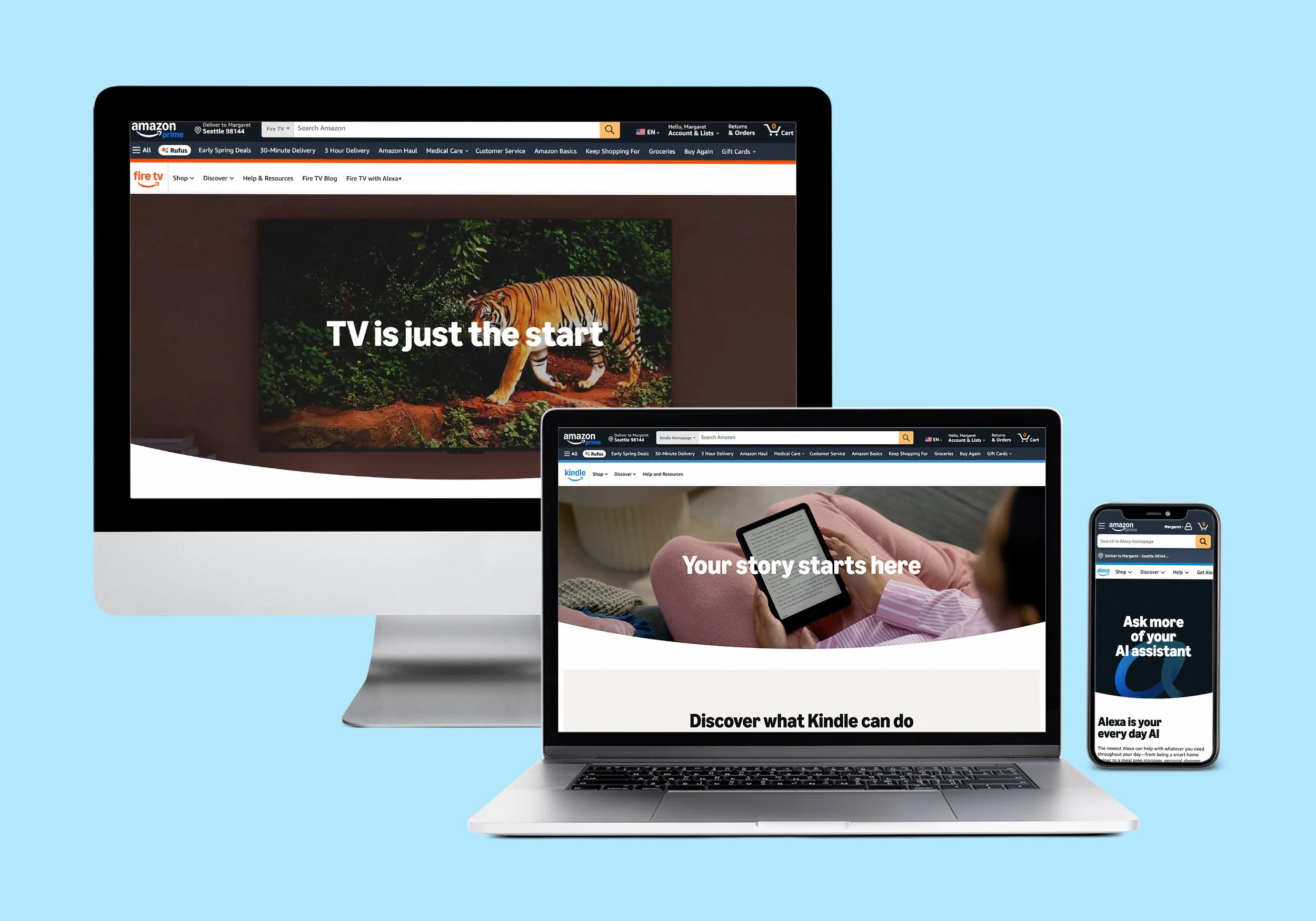
Built brand storefronts for Alexa, Kindle, and Fire TV from scratch inside Amazon.com—creating the first destination where customers could discover an entire product portfolio and engage with a brand story, not just a single product—driving 36.6M sessions in the first 6 months and a 9.1% conversion rate increase among customers who engaged with both storefront and detail page.
The problem
Amazon Devices had pages to tell individual product stories, but nowhere to tell the story of an entire brand or help customers navigate a full product portfolio. The gap between a Kindle Paperwhite detail page—which tells you everything about one product—and Kindle.com—which would tell you what Kindle stands for, what the full product family looks like, and why it belongs in your life—didn't exist. Closing that gap meant solving a problem unique to Amazon: as both manufacturer and marketplace, building outside Amazon.com would mean recreating an entire e-commerce infrastructure at Amazon's standard of security, fulfillment, and customer expectation. Building inside Amazon.com meant a brand experience competing with Amazon's parent identity and a site architecture built for transactional shopping. There was no obvious answer—just tradeoffs that needed to be made explicitly.
My role
I led the strategic, organizational, and design work that turned a fundamentally ambiguous brief—"we need brand sites"—into three launched storefronts with a shared framework, a funded team, and executive alignment across multiple business lines.
That included navigating a significant people leadership challenge mid-project. My senior designer who had developed the site framework and initial designs left Amazon due to return-to-work policy changes, taking institutional knowledge with her at a moment when we had a hard deadline bearing down: our first SVP review. I moved quickly to hire a replacement, deliberately selecting someone who could inherit a strong framework and move fast on the details rather than starting over. The foundation held, the hire ramped quickly, and we made the deadline without losing meaningful momentum.
I also set design up to operate as a translator between the brand team's creative vision and what product and technology leaders could understand and fund—a role that turned out to be as important as any design decision we made.
What I did
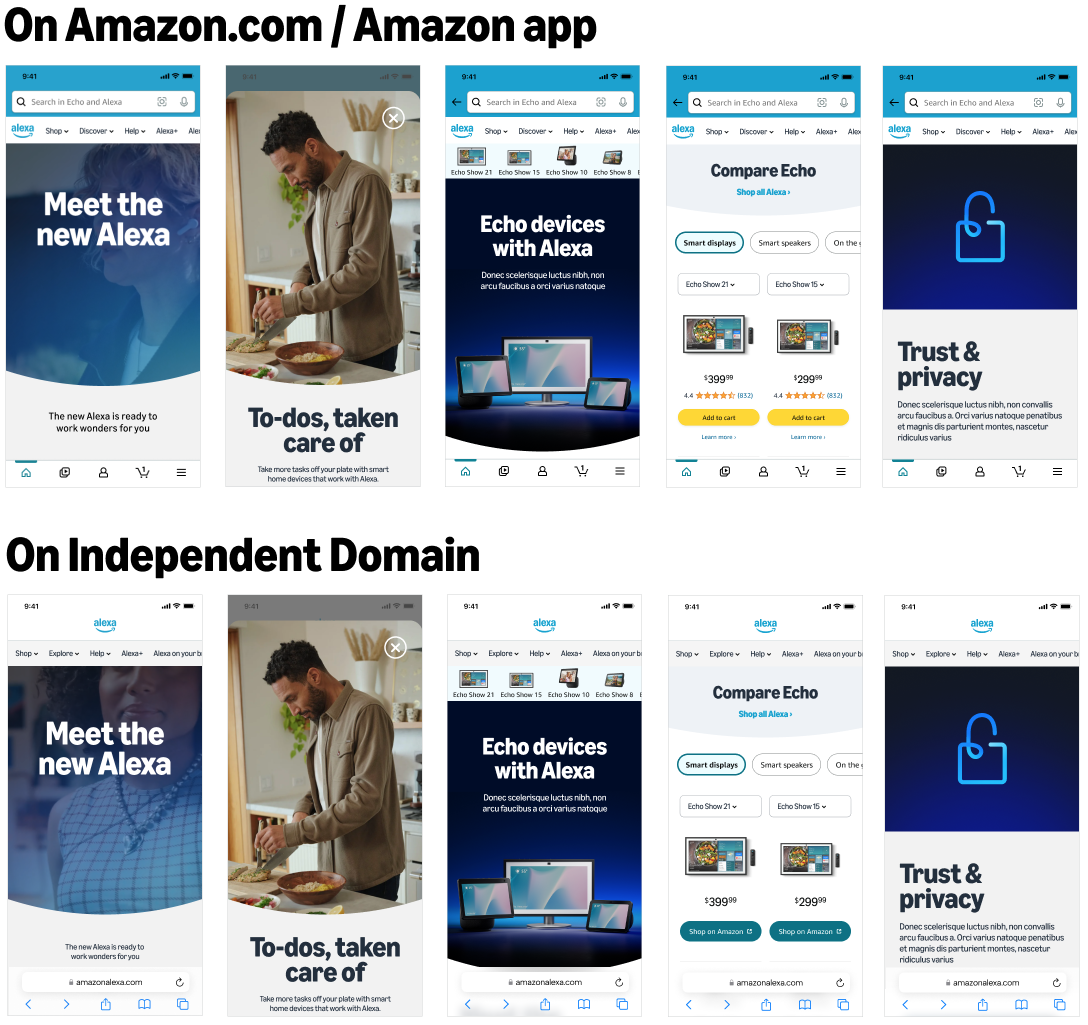
Made the strategic tradeoff explicit so executives could actually decide. The organization wanted both brand expression and sales results—without acknowledging those goals were in tension. My team built interactive prototypes showing what the experience would look like in each scenario: a standalone brand domain versus an Amazon-hosted storefront. I mapped the design and business tradeoffs of each option clearly, including the significant cost and resourcing implications of building off Amazon.com. My recommendation was direct: if the priority was brand metrics, choose the independent domain; if the priority was sales metrics, choose Amazon.com. That framing gave the SVP and his executive team something concrete to align on, and it surfaced the funding question that needed to be resolved in the same conversation.
Translated brand needs into a UX and technology investment case. The brand team knew they needed motion—they could articulate why it mattered emotionally, but couldn't connect it to something product and tech leaders would fund. I made that connection. I reframed motion not as a visual preference but as a functional expression of Alexa+'s core capability: the fluid, generative, real-time nature of the on-device experience needed to be mirrored in the storefront experience. Since we hadn't built motion-heavy features before, the team had nothing to draw from. I assigned motion feature design to a mid-level designer who quickly identified the need for a motion design system to drive consistency across features—and built one. The conversation with product and tech leadership shifted from "why do we need motion" to "this is a critical element of brand expression" and the prioritization followed.
Built a flexible framework that made multiple competing brands agree. Alexa, Kindle, and Fire TV each had different priorities, different content requirements, and different ideas about how their brand should show up. Scaling the investment in features and frameworks required a consistent architecture—and customers navigating across brands deserved predictability. I gathered content and page requirements from each business, worked with my team to propose a flexible framework that accommodated those needs, and brought sitemaps back to business leaders for debate. Where alignment was difficult, we ran tree testing research with customers to take opinion out of the equation. UX didn't win every argument, but we landed on an architecture everyone could commit to—with a clear plan to experiment and optimize after launch.
Drove the design exploration and materials that turned an open executive question into a funded direction. The first SVP meeting wasn't a pitch — it was a structured decision briefing built on work my team and I developed: interactive prototypes showing what each option would actually look like, with a clear articulation of the tradeoffs. The SVP's response reoriented the project: he acknowledged he'd asked us to explore the independent domain option, but concluded on the spot it was the wrong call and asked us to come back with a detailed proposal for building on Amazon.com. I used that redirect as the alignment signal we needed—we returned with a higher-fidelity prototype of the Amazon-hosted experience, the resourcing ask, and a clear framework for what the sites would need to accomplish. The second meeting converted that direction into a funded commitment across the business line teams.
See below key screens from the prototypes presented to the SVP demonstrating how closely we thought we could get the the Amazon-hosted version to the independent domain version:
The outcome
Launched three brand storefronts on Amazon.com for Alexa, Kindle, and Fire TV—a surface that had never existed before in Amazon's marketplace. The storefronts drove 36.6M sessions in the first 6 months, and customers who engaged with both a storefront and a detail page converted at a 9.1% increase—demonstrating that brand engagement and purchase intent reinforce each other when the experience is designed to connect them.
See video of the launched experiences below:
The final experience balanced brand storytelling and product discovery within Amazon's marketplace constraints—something no Amazon Devices surface had done before.
What this demonstrates
Retailers navigating the intersection of brand and commerce face a version of this problem constantly —how do you tell a brand story that builds loyalty without losing the customer before they buy? This project shows how I think through that tension strategically, build the organizational alignment to act on a decision, and deliver an experience that serves both goals without compromising either. The transferrable skill isn't Amazon-specific—it's knowing how to hold brand and transaction together when every stakeholder is pulling in a different direction.
What I’d do differently
We found significant misalignment on the site maps with VP-level leadership late in the process—mostly around the maps not reflecting business and brand priorities at the right strategic altitude. In retrospect, that gap came from building our initial site maps through working sessions with individual contributors who weren't operating at the level where those priorities get set. By the time we got the work in front of executive leadership, we had iterated on a foundation that needed more fundamental rethinking than we had time for, particularly for the highly complex Alexa brand.
If I were doing this again, I'd bring executive-level stakeholders into the site architecture conversations much earlier—not to design by committee, but to pressure-test the strategic assumptions before the team invests in the details. The individual contributor working sessions are still valuable for getting the content right, but the strategic framing of what each brand site needs to accomplish has to come from the people who own those business priorities.